Teochew cuisine is one of the more quietly expressive food traditions in Chinese culinary culture. Where other regional styles lean towards bold flavours and elaborate preparation, Teochew cooking prizes freshness, restraint and a kind of culinary honesty that lets quality ingredients speak without much interference. But behind that apparent simplicity lies a rich set of associations—dishes tied to festivals, family rituals and a deeply held sense of cultural identity that Teochew communities have carried across generations and across borders. In Singapore, where the Teochew diaspora has put down particularly strong roots, these dishes remain as meaningful at the table today as they have ever been.
Here are five Teochew dishes from our menu that carry genuine cultural and symbolic weight, and the stories behind them.
1. Marinated Raw Roe Crab (生腌膏蟹)
Few dishes are as emblematic of Teochew identity as the marinated raw crab, and the roe crab version is its most prized expression. Live female crabs are selected at the peak of their season, when the roe is fullest, and carefully marinated in a seasoned brine using methods passed down through generations. The result is a dish of extraordinary delicacy—intensely flavoured, deeply savoury and almost impossibly fresh.
The cultural significance of raw marinated crab in Teochew tradition runs deep. It is a dish associated with abundance and with the confidence to let exceptional produce stand without the intervention of heat, a philosophy that sits at the very centre of the Teochew culinary worldview. Among Teochew families, the ability to prepare a good marinated crab is a point of real pride, and the dish appears at family gatherings and celebratory meals as a signal that no effort has been spared. At Fu Yuan Teochew Dining, it is available by advance order only, which is itself a nod to the care and timing the dish demands.
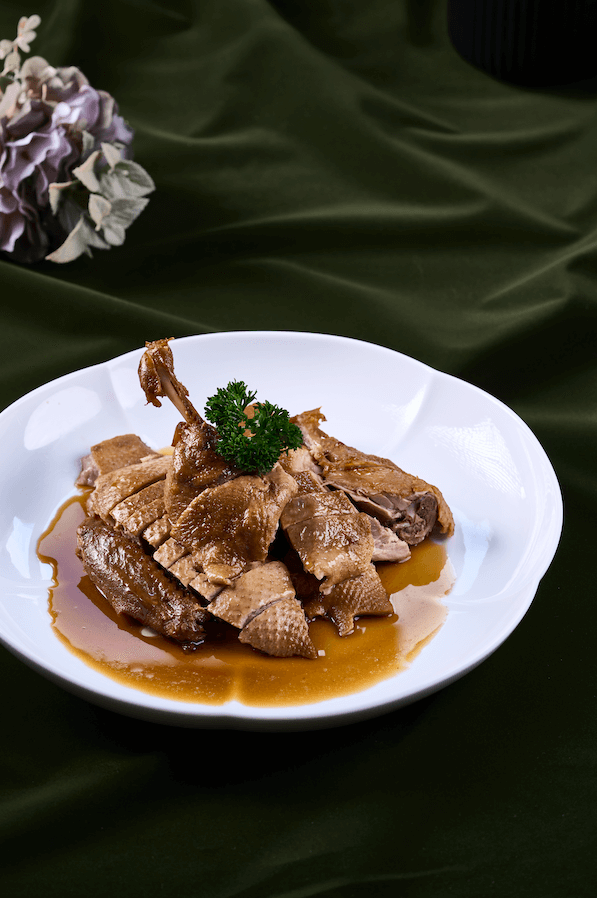
2. Braised Duck (卤爱尔兰鸭)
The Teochew braised platter, or lor bak, is one of the oldest and most culturally significant preparations in the tradition. Meats and seafood are slowly braised in a deeply aromatic master stock built from soy sauce, galangal, five spice and other aromatics, producing a dish that is at once deeply savoury and remarkably nuanced. The braised duck is its most celebrated expression.
In Teochew communities, the braised master stock is treated almost as a living thing. Families have maintained and replenished their lor for decades, passing the stock from one generation to the next as a form of culinary inheritance. The braised duck also appears prominently at ancestral offerings and festive celebrations, where it signals respect for tradition and continuity. To serve a good lor ark is to connect the present table to a very long line of tables before it.
3. Live Marble Goby, Pan-Fried Teochew Style With Shark Cartilage Soup (潮州半煎煮鲨鱼骨汤笋壳)
Whole fish holds a specific symbolic place in Chinese dining culture. In Teochew cuisine specifically, the traditions around its preparation and presentation are particularly considered. A whole fish served at the table represents abundance and completeness, and the Teochew method of pan-frying the fish until the exterior is crisp before finishing it in a rich, clear shark cartilage broth is a technique that balances texture and flavour with characteristic precision.
The marble goby, known locally as soon hock, is a fish of prestige in the Teochew culinary world, prized for its clean, sweet flesh and its relative scarcity. To serve it whole, cooked to order, and in a method as refined as the Teochew half-pan-fried style is a gesture of generosity and esteem towards guests. It is a dish that communicates that the occasion, and the people at the table, are worth the effort.
4. Pan-Fried Oyster Omelette (潮州蚝煎)
The oyster omelette is one of the most widely recognised Teochew exports, found across Southeast Asia in various forms, but the Teochew original carries a specific cultural resonance that its derivatives rarely replicate. Made with plump, fresh oysters folded into an egg and starch batter and pan-fried until the edges are properly crisp while the centre remains soft, it is a dish rooted in the coastal food culture of the Chaoshan region, where oysters were historically abundant and the omelette was a practical, celebratory way to make the most of them.
The oyster omelette is comfort food in the truest sense, deeply familiar, tied to memories of hawker stalls and home kitchens, and carrying a nostalgic weight that more refined dishes don’t quite achieve. It is also a dish that separates the careful cook from the careless one. The balance of crisp and soft, the quality of the oysters, and the restraint of the seasoning are all immediately apparent in every bite.
5. Mashed Taro ‘Orh Nee’ (潮州芋泥)
If there is a single dessert that defines the Teochew table, it is orh nee. A smooth, silken paste made from steamed and mashed taro, enriched with lard and finished with a gentle sweetness, it is served warm and accompanied by gingko nuts and sometimes a thin drizzle of coconut milk. The preparation is laborious, to say the least. Good orh nee requires patience, quality taro, and a careful hand, and it is precisely because of that effort that the dish has long been reserved for special occasions.
Orh nee appears at weddings, birthday celebrations and ancestral offerings, where its smooth texture and natural sweetness are understood as gestures of goodwill and blessing towards the people being honoured. In a culinary tradition that otherwise prizes savoury restraint, a bowl of warm orh nee at the close of a meal carries a quiet but unmistakable emotional register. It is the kind of dish that, for anyone who grew up eating it, needs no explanation at all.
Food, Values and Memories
Food is one of the more reliable ways a culture keeps itself intact, and Teochew cuisine is a particularly good example of that. These five dishes have outlasted trends, borders and generations precisely because they mean something beyond what is on the plate. Fu Yuan Teochew Dining is where that tradition continues—book your table and experience it firsthand.